Import & Export
How to find the HS code (PCT code) for your product in Pakistan
HS code Pakistan: FBR's Pakistan Customs Tariff 2026-27 PDF lists the 8-digit PCT codes and customs duty. Where to download it and how to find your code.
Import & Export · Business & Trade
How to import from China to Pakistan in 2026: PSW and NTN, paying the supplier, sea or Khunjerab road, FTA duty cuts and the certificate of origin you need.
AI Summary
To import from China to Pakistan commercially you need an NTN, a Rs 500 PSW subscription and a bank profile linked in PSW; no general import licence is needed unless the goods are banned or restricted. Pay through your bank by LC, advance payment or collection. Phase II of the Pakistan-China FTA made 3,251 tariff lines duty free from January 2020 and cuts others over time, but you need a China-Pakistan FTA certificate of origin to claim it. Imports from China were $19.5 billion in FY26.
To import from China to Pakistan as a business, you need an NTN, a Rs 500 PSW subscription and a bank profile linked in Pakistan Single Window (PSW), as of October 2026. You pay the supplier through your bank, ship by sea or by road over the Khunjerab Pass, and clear Pakistan Customs here. Many goods pay less duty under the Pakistan-China free trade agreement (FTA), but only with a China-Pakistan FTA certificate of origin.
Imports from China, FY26
$19.5 billion
Up 19.8% from FY25, per SBP data reported by Qatar Tribune on 23 Jul 2026. China supplies about 98% of what Pakistan imports from its nine neighbours.
The Import Policy Order, 2022 lets you import goods from any country unless they are banned, prohibited or restricted. There is no general import licence. What you do need:
Check that your goods aren’t on a banned or restricted list first; our import and export licence guide has the lists. Some used goods are banned too: goods in Appendix-C of the Order can’t come in second-hand unless specifically exempted.
The Import Policy Order allows all modes of payment, subject to State Bank of Pakistan procedures. Your bank sends the payment instrument (LC, advance payment or contract) to PSW. The usual routes:
| Payment route | How it works | Watch out for |
|---|---|---|
| Letter of credit (LC) | Your bank pays against the supplier’s shipping documents, such as the bill of lading | Bank charges; see our LC guide |
| Advance payment | Bank pays up to 100% upfront against an LC or invoice | Goods must arrive within 120 days (730 for plant and machinery) or a 0.1% a day penalty applies |
| Contract or collection | You register the contract or proforma with your bank, which pays when documents arrive from the supplier’s bank | Bank registration and handling charges |
The advance payment rules apply from 30 January 2024, under SBP’s EPD Circular Letter No. 01 of 2024.
Alibaba.com’s Trade Assurance covers orders agreed with a supplier and paid through Alibaba.com. Your payment is held in escrow and released to the supplier after you confirm the goods arrived.
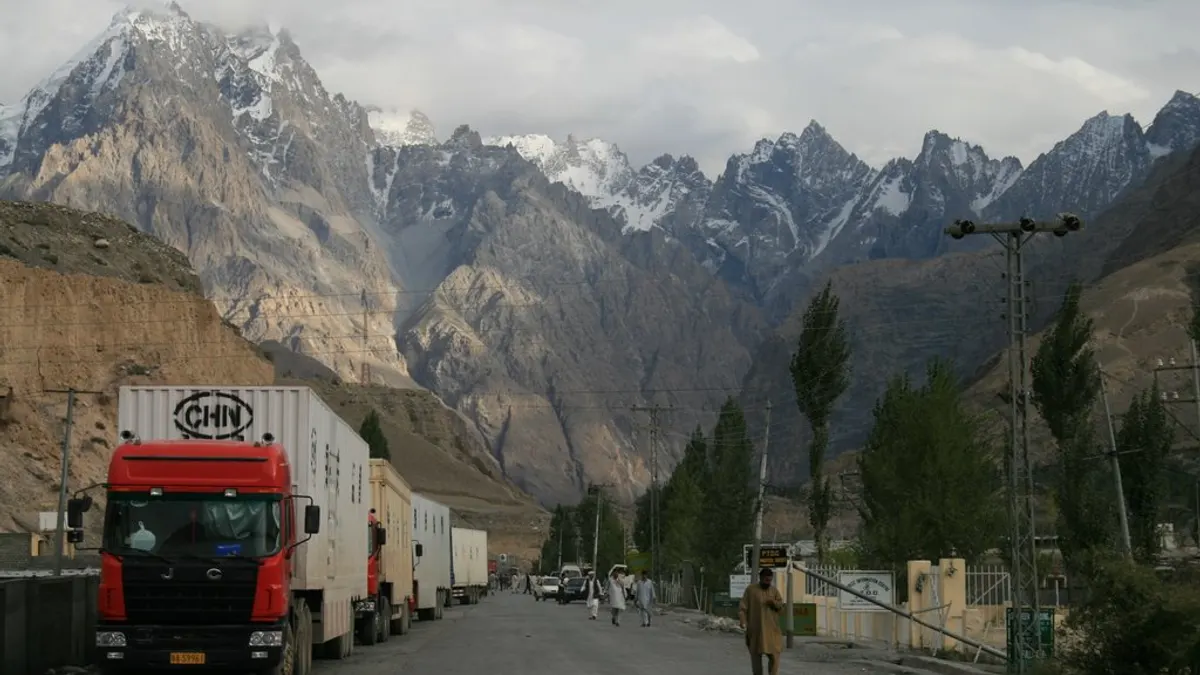
Yes. The road route crosses the Khunjerab Pass to the Sost dry port in Gilgit-Baltistan. The border has traditionally closed every year on 30 November because of snow. In winter 2024-25, Pakistan and China kept it open for trade from 1 December 2024 to 30 April 2025, for the first time, Nukta reported. We couldn’t confirm whether that was repeated in winter 2025-26, and as of October 2026 we found no dates for the 2026-27 winter.
In July 2026 the National Logistics Board told NLC to prioritise expanding the Sost dry port and building a Khunjerab border terminal, Radio Pakistan reported.
For sea and air freight, we don’t publish cargo rates per kg or transit times: the figures we found were forwarders’ adverts, not dated price lists. Get written quotes from two or three freight forwarders and ask whether they include clearing in Pakistan.
The duty depends on the HS code of your goods. Customs charges duty on the transaction value, the price actually paid for export to Pakistan (section 25 of the Customs Act), then adds the other duties and taxes. Our customs duty guide shows how the layers stack, with a worked example.
The FTA lowers the customs duty on many goods from China. Phase II took effect on 1 January 2020 under S.R.O. 1640(I)/2019:
| FTA category | What happens to customs duty |
|---|---|
| A0 | Zero from 1 January 2020 (3,251 tariff lines) |
| A7 | Cut to zero between years 2 and 7 |
| A15 | Cut to zero between years 4 and 15 |
| MOP1, MOP2 | Cut by 20% of the base rate |
| C1 | Stays at the base rate |
| C2 | No concession |
About a quarter of tariff lines (1,760 items) are on a protected list, China Briefing reports. It covers sectors such as textiles and clothing, iron and steel, autos, electrical equipment, footwear and leather. Protected items keep their tariff protection, so check carefully if your goods are in these sectors. Look up your exact HS code in the SRO’s schedule before you work out your landed cost.
To claim the FTA rate, the shipment needs a Certificate of Origin, China-Pakistan FTA. The Chinese exporter fills it in, and a certifying authority in China checks and stamps it. Pakistan Customs then marks on the same form whether it gave the lower rate.
The form lists the exporter, consignee, producer, route, each item with its 6-digit HS code, the invoice number and the origin criterion. Goods qualify if they are wholly made in China, or if materials from outside the FTA or of unknown origin are less than 60% of the FOB value and the last process happened in China. Some goods follow product-specific rules instead.
Ask your supplier for this certificate when you agree the order. Without it, you can’t claim the FTA rate.
More guides: How to start an import export business · Importing construction machinery from Japan · Car import rules · Import & Export
For many goods, yes. Under Phase II of the Pakistan-China FTA (S.R.O. 1640(I)/2019), duty on 3,251 tariff lines went to zero from 1 January 2020 and others are cut over up to 15 years, but about a quarter of tariff lines are protected. You need a China-Pakistan FTA certificate of origin to claim the lower rate.
Yes, through the Khunjerab Pass and the Sost dry port in Gilgit-Baltistan. The border traditionally closes on 30 November for the winter, though it stayed open in winter 2024-25.
Goods you order on Alibaba still clear Pakistan Customs, and you pay duty here. Alibaba's Trade Assurance holds your payment in escrow and lets you claim a refund within 30 days of delivery.
There is no general import licence. Under the Import Policy Order, 2022 you can import from anywhere unless the goods are banned or restricted, but you need an NTN and a PSW subscription (Rs 500) to clear goods.
Photo: Anthony Maw, Vancouver, Canada / CC BY-SA 3.0
Ask us. We read every question and reply by email when you leave one.
Import & Export
HS code Pakistan: FBR's Pakistan Customs Tariff 2026-27 PDF lists the 8-digit PCT codes and customs duty. Where to download it and how to find your code.
Import & Export
Used excavator price in Pakistan: OLX asking prices in Oct 2026, what to inspect, the customs GD and Excise papers to ask for, and leasing options.
Import & Export
Car import to Pakistan in 2026: personal baggage is gone, gift and transfer of residence remain. Who qualifies, the 3-year age limit, 850-day rule and duty.