Loans & Home Finance
Mera Pakistan Mera Ghar 2026: status, rates and how to apply
Mera Pakistan Mera Ghar was put on hold in July 2022. Its 2026 successor, Apna Ghar, lends up to Rs 1 crore at 5% for 10 years. Rules and how to apply.
Loans & Home Finance · Money
A home loan in Pakistan costs 1-year KIBOR plus 3% to 4% at most banks, about 15.7% to 16.7% in Oct 2026. Rates, financing and eligibility at 8 lenders.
AI Summary
Most Pakistani banks price home loans at 1-year KIBOR plus 3% to 4%, repriced every year. With 1-year KIBOR at 12.73% on 9 October 2026, that is about 15.7% to 16.7%. Banks finance 70% to 85% of the property's value for up to 25 years, and ask for Rs 50,000 to Rs 1.5 lakh a month in income. Islamic banks use Diminishing Musharakah but still benchmark to KIBOR. SBP caps your total consumer-loan repayments at 65% of net disposable income.
A home loan in Pakistan costs 1-year KIBOR plus 3% to 4% at most banks, repriced once a year. With 1-year KIBOR at 12.73% on 9 October 2026, that is about 15.7% to 16.7% a year. Banks finance 70% to 85% of the property’s value, for up to 25 years, and want a monthly income of Rs 50,000 to Rs 1.5 lakh. All figures come from the banks’ own pages and SBP, as of October 2026.
KIBOR is the Karachi Interbank Offered Rate, the benchmark banks add their margin (the “spread”) to. It moves with the market: SBP’s sheet showed 1-year KIBOR at 12.19% on 4 September 2026 and 12.73% on 9 October 2026. Your instalment changes when the bank reprices.
The spread is the bank’s margin over KIBOR; most banks here reset KIBOR each year. The “approx. rate” column adds the spread to 1-year KIBOR of 12.73% (6-month KIBOR of 12.41% for MCB) on 9 October 2026. Your bank uses KIBOR from its own reference date, so your rate will differ.
| Bank and product | Type | Pricing (salaried) | Pricing (self-employed) | Approx. rate, Oct 2026 |
|---|---|---|---|---|
| Meezan Easy Home | Islamic | KIBOR + 3% | KIBOR + 4% (businessmen) | 15.7% to 16.7% |
| HBL Islamic HomeFinance | Islamic | 1-yr KIBOR + 3% (existing customer), + 3.2% (new) | + 3.1% to + 4.2% | 15.7% to 16.9% |
| UBL Address | Conventional | 1-yr KIBOR + 3.5% | 1-yr KIBOR + 4% | 16.2% to 16.7% |
| UBL Ameen Address | Islamic | 1-yr KIBOR + 3.5% | 1-yr KIBOR + 3.5% | 16.2% |
| MCB Home Loan | Conventional | 6-month KIBOR + 2% to 3% | 6-month KIBOR + 2.5% to 3.5% | 14.4% to 15.9% |
| Bank Alfalah Home Finance | Conventional | 1-yr KIBOR + 3% | 1-yr KIBOR + 4% | 15.7% to 16.7% |
| Bank AL Habib | Conventional | 1-yr KIBOR + 3% | 1-yr KIBOR + 3.5% | 15.7% to 16.2% |
| HBFC (non-residents) | Specialist lender | 1-yr KIBOR + 3% | n/a | 15.7% |
MCB is the only bank here that lowers the spread for a bigger down payment: salaried borrowers pay KIBOR + 3% with under 30% equity, + 2.5% with 30% to under 50%, and + 2% with 50% or more. Meezan and HBL Islamic set a floor of 8% and a cap of 30% on the rate (HBL’s from a 2018 brochure).
| Bank | Bank’s share of value | Loan size | Tenure |
|---|---|---|---|
| Meezan Easy Buyer | Up to 75% (salaried, professionals, non-residents); 70% (businessmen) | Rs 10 lakh to Rs 10 crore | 3 to 25 years |
| HBL Islamic HomeFinance | Up to 70% | Rs 20 lakh to Rs 10 crore | 3 to 25 years |
| UBL Address | Not stated | From Rs 10 lakh | Not stated |
| UBL Ameen Address | 80% up to Rs 2 crore; 75% above; 70% above Rs 3 crore | Rs 10 lakh to Rs 5 crore | 3 to 20 years |
| MCB Home Loan | Not stated (pricing tiers start below 30% equity) | Up to Rs 5 crore or higher | 2 to 25 years |
| Bank Alfalah | Up to 80%; 20% equity generally required | No minimum or maximum | 3 to 25 years |
| Bank AL Habib | 75% to 85% of appraised value | Rs 3 lakh to Rs 10 crore | 1 to 25 years |
| HBFC (non-residents) | Up to 85% | Up to Rs 6 crore in selected cities | 3 to 20 years |
So plan on paying 15% to 30% of the price yourself, plus legal, valuation and processing charges. Meezan’s page gives a second, different split lower down (75% salaried, 65% businessmen); we used the figures in its Easy Buyer section.
| Bank | Age | Minimum income, salaried | Minimum income, self-employed |
|---|---|---|---|
| Meezan | 25 to 65 at maturity (salaried: not past retirement) | Rs 50,000 gross | Rs 1 lakh gross (businessmen) |
| HBL Islamic | Salaried 25+, 60 at maturity; self-employed 30+, 65 at maturity | Rs 50,000 | Rs 1 lakh |
| UBL Address | 21 to 65 | Rs 1.5 lakh | Rs 1.5 lakh |
| MCB | 25 minimum; 65 or retirement at maturity | Rs 75,000 net | Rs 1 lakh net |
| Bank Alfalah | Salaried 25 to retirement; self-employed 25 to 70 | Rs 75,000 net | Rs 1.5 lakh net |
| Bank AL Habib | Not stated | Rs 60,000 | Rs 60,000 |
Banks also want a work record. Meezan and MCB ask for 2 years in a permanent job and 3 years in business. HBL Islamic’s 2018 brochure asks salaried applicants for 5 years in the same field.
You can usually add family income. Meezan counts 100% of a spouse’s income. Bank Alfalah allows up to two co-borrowers: spouse, parents, children or siblings. Bank AL Habib wants a co-borrower to earn at least Rs 30,000.
Every bank must pull your credit report from SBP’s e-CIB (Electronic Credit Information Bureau) or a licensed private bureau. Clear any overdue payment before you apply.
SBP’s housing finance rules, updated on 18 August 2026, cap your home loan plus all other consumer loan repayments at 65% of net disposable income.
Rs 1 crore over 20 years at 15.73%
About Rs 1.37 lakh a month
1-year KIBOR 12.73% (9 Oct 2026) + 3%. At the 65% cap you need about Rs 2.11 lakh a month in net income, with no other loans. Our calculation; bank schedules differ.
Salaried applicants usually need:
Self-employed applicants need 3 years of tax returns (UBL, Meezan) and an NTN certificate (Meezan), plus 2 years of bank statements at UBL. SBP now requires banks to use simplified, standard application forms in Urdu and English, with separate forms for salaried, business and informal-income applicants.
Bank Alfalah gives an in-principle approval before you pick a property, valid for 60 days.
Meezan, HBL Islamic and UBL Ameen use Diminishing Musharakah. You and the bank jointly own the house. You pay rent on the bank’s share and buy its share in units over time until you own the whole house.
The price is still set against KIBOR. In our table, Islamic and conventional rates sit in the same range.
The real differences are in the small print:
For a wider look at Islamic banks, see Meezan Bank vs other banks.
SBP’s revised housing finance rules took effect immediately on 18 August 2026. The main limits:
These are ceilings. In October 2026 the banks we checked still offered at most 25 years and 70% to 85% financing.
Yes, at several lenders, with stricter terms. HBL Islamic takes salaried non-residents earning the equivalent of Rs 4 lakh a month, at 1-year KIBOR + 4%. Bank Alfalah asks for USD 3,000 a month at KIBOR + 4%. MCB’s variant needs Rs 5 lakh a month and a local co-borrower. HBFC lends non-residents up to 85% at KIBOR + 3%, aged 23 to 60.
If you have a Roshan Digital Account, see investing through a Roshan Digital Account, which covers Roshan Apna Ghar.
Yes. Under the Prime Minister’s Apna Ghar Scheme, banks lend up to Rs 1 crore for 20 years at a fixed 5% for the first 10 years, with no processing fee and no prepayment penalty. SBP officials gave these terms at a media briefing reported by Profit on 24 July 2026; we couldn’t open SBP’s own release. See government housing finance schemes.
Before you borrow against a plot or house, check the society’s approval status: see our property guides.
More guides: Loans & Home Finance, best bank in Pakistan, investment options in Pakistan, Money.
Most banks charge 1-year KIBOR plus 3% to 4%. With 1-year KIBOR at 12.73% on 9 October 2026, that is about 15.7% to 16.7% a year, repriced every year.
Islamic banks offer home finance through Diminishing Musharakah: you pay rent on the bank's share of the house and buy that share over time. The profit rate is still benchmarked to KIBOR. Meezan Easy Home charges KIBOR + 3% to salaried customers.
Yes. HBL Islamic asks salaried non-residents for income equal to Rs 4 lakh a month, Bank Alfalah for USD 3,000 a month, and HBFC finances up to 85% of the value for non-residents at 1-year KIBOR + 3%.
Bank minimums run from Rs 50,000 a month (Meezan, HBL Islamic, salaried) to Rs 1.5 lakh (UBL Address). SBP also caps your total consumer-loan repayments at 65% of net disposable income, so the loan size depends on your income.
Yes. Under the Prime Minister's Apna Ghar Scheme, banks lend up to Rs 1 crore for 20 years at a fixed 5% for the first 10 years, according to SBP officials quoted by Profit in July 2026.
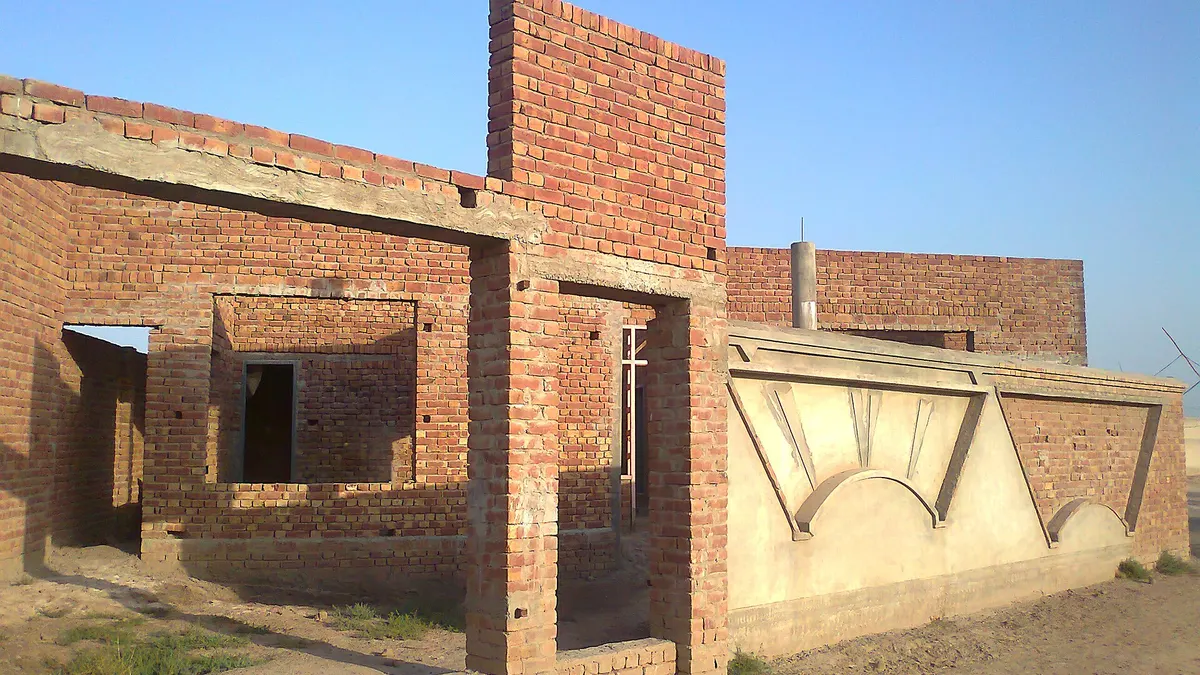
Photo: Shixart1985 / CC BY 2.0
Loans & Home Finance
Mera Pakistan Mera Ghar was put on hold in July 2022. Its 2026 successor, Apna Ghar, lends up to Rs 1 crore at 5% for 10 years. Rules and how to apply.
Banking & Payments
Which is the best bank in Pakistan? Ratings, deposit protection, branches, Islamic options and everyday fees for HBL, UBL, MCB, NBP, Meezan and more, Oct 2026.
Banking & Payments
Which digital bank in Pakistan is licensed: Easypaisa Bank, Mashreq and Raqami operate, HugoBank is in a pilot. Savings rates, card fees and deposit cover.