Tax & Registration
Salary tax calculator 2026-27: your monthly tax under the new slabs
Salary tax calculator for 2026-27: enter your monthly salary to see the tax your employer deducts under FBR's new slabs, your take-home pay and last year's tax.
Tax & Registration · Business & Trade
Income tax calculator for Pakistan 2026-27: salaried slabs run from 0% to 35% and business slabs from 0% to 45%. Full FBR tables, changes and worked examples.
AI Summary
For tax year 2027 (1 July 2026 to 30 June 2027), salaried individuals pay nothing on the first Rs 6 lakh of taxable income, then rates rise across eight slabs to 35% above Rs 70 lakh. The Finance Act 2026 cut four salaried bands and removed the 9% surcharge on high salaries. Business individuals and AOPs keep last year's six slabs, 0% to 45% above Rs 56 lakh, plus a 10% surcharge above Rs 1 crore. Salary counts as salaried only if it exceeds 75% of taxable income.
For tax year 2027 (1 July 2026 to 30 June 2027), the first Rs 6 lakh of taxable income is tax-free. Above that, salaried people pay rising rates across eight slabs, up to 35% above Rs 70 lakh. Business individuals and partnerships pay higher rates, up to 45% above Rs 56 lakh. The tables below come from FBR’s copy of the Income Tax Ordinance as amended by the Finance Act 2026. To skip the maths, use our income tax calculator for Pakistan salaries.
The Ordinance has two tables for individuals:
So a salaried person who also earns a lot from a side business can fall into the non-salaried table. Both tables work on taxable income, not gross pay. The tax year is named after the 30 June it ends on, so “2026-27” and “tax year 2027” mean the same year.
These are the rates in the First Schedule, Part I, Division I, clause (2), as substituted by the Finance Act 2026. FBR’s withholding rate card lists the same eight slabs.
| Annual taxable income | Tax |
|---|---|
| Up to Rs 6 lakh | 0% |
| Rs 6 lakh to Rs 12 lakh | 1% of the amount above Rs 6 lakh |
| Rs 12 lakh to Rs 22 lakh | Rs 6,000 + 11% above Rs 12 lakh |
| Rs 22 lakh to Rs 32 lakh | Rs 1.16 lakh + 20% above Rs 22 lakh |
| Rs 32 lakh to Rs 41 lakh | Rs 3.16 lakh + 25% above Rs 32 lakh |
| Rs 41 lakh to Rs 56 lakh | Rs 5.41 lakh + 29% above Rs 41 lakh |
| Rs 56 lakh to Rs 70 lakh | Rs 9.76 lakh + 32% above Rs 56 lakh |
| Above Rs 70 lakh | Rs 14.24 lakh + 35% above Rs 70 lakh |
The percentage applies only to the part of your income inside that band. The fixed amount is the tax on everything below the band.
Finance Minister Muhammad Aurangzeb presented the budget on 12 June 2026. The National Assembly passed the Finance Bill on 26 June, and the Finance Act 2026 was enacted on 27 June, effective from 1 July 2026, according to KPMG’s brief.
| Annual taxable income | Tax year 2026 rate | Tax year 2027 rate |
|---|---|---|
| Up to Rs 22 lakh | 0%, 1%, 11% | No change |
| Rs 22 lakh to Rs 32 lakh | 23% | 20% |
| Rs 32 lakh to Rs 41 lakh | 30% | 25% |
| Rs 41 lakh to Rs 56 lakh | 35% | 29% |
| Rs 56 lakh to Rs 70 lakh | 35% | 32% |
| Above Rs 70 lakh | 35% | 35% |
The Act also removed the surcharge on salaried individuals. The surcharge started at 10% in 2024 and was cut to 9% for salaried people in 2025. Now none applies to individuals deriving income under the head “Salary”.
So if you earn up to Rs 22 lakh a year (about Rs 1.83 lakh a month), your tax hasn’t changed. The cut starts above that.
For comparison, in tax year 2025 the salaried table charged 5% (not 1%) between Rs 6 lakh and Rs 12 lakh, and 15% (not 11%) up to Rs 22 lakh.
Our calculations below assume your whole salary is taxable income, with no exempt allowances, tax credits or other income. The 2026 column uses last year’s table.
| Monthly salary | Tax a year (2027) | Tax a month (2027) | Tax a year (2026) |
|---|---|---|---|
| Rs 50,000 | Rs 0 | Rs 0 | Rs 0 |
| Rs 1 lakh | Rs 6,000 | Rs 500 | Rs 6,000 |
| Rs 1.5 lakh | Rs 72,000 | Rs 6,000 | Rs 72,000 |
| Rs 2 lakh | Rs 1.56 lakh | Rs 13,000 | Rs 1.62 lakh |
| Rs 2.5 lakh | Rs 2.76 lakh | Rs 23,000 | Rs 3 lakh |
| Rs 3 lakh | Rs 4.16 lakh | About Rs 34,667 | Rs 4.66 lakh |
| Rs 5 lakh | Rs 11.04 lakh | Rs 92,000 | Rs 12.81 lakh |
| Rs 10 lakh | Rs 31.74 lakh | Rs 2.645 lakh | Rs 36.85 lakh (incl. 9% surcharge) |
KPMG’s impact table gives the same figures for Rs 1.2 crore a year: Rs 36,85,290 before, Rs 31,74,000 after.
Rs 2.5 lakh a month, tax year 2027
Rs 23,000 a month
Rs 1.16 lakh on the first Rs 22 lakh, plus 20% of Rs 8 lakh. Our calculation from the Ordinance table.
Under section 149, your employer deducts tax from every salary payment. It works out the tax on your estimated salary for the whole year, turns that into an average rate, and applies it to each payment.
The credits your employer can adjust under section 149 are for charitable donations (section 61) and contributions to an approved pension fund (section 63), if you give documentary evidence. See our guide to pension funds in Pakistan.
The Finance Act 2026 did not change the rates for business individuals and AOPs, KPMG confirms. The table was last set by the Finance Act 2024.
| Annual taxable income | Tax |
|---|---|
| Up to Rs 6 lakh | 0% |
| Rs 6 lakh to Rs 12 lakh | 15% of the amount above Rs 6 lakh |
| Rs 12 lakh to Rs 16 lakh | Rs 90,000 + 20% above Rs 12 lakh |
| Rs 16 lakh to Rs 32 lakh | Rs 1.7 lakh + 30% above Rs 16 lakh |
| Rs 32 lakh to Rs 56 lakh | Rs 6.5 lakh + 40% above Rs 32 lakh |
| Above Rs 56 lakh | Rs 16.1 lakh + 45% above Rs 56 lakh |
An AOP that is a professional firm barred from incorporating by law or by its regulator pays 40% instead of 45% on the top band.
Same taxable income, tax year 2027, our calculations from the two tables:
| Taxable income a year | Salaried | Business individual or AOP |
|---|---|---|
| Rs 12 lakh | Rs 6,000 | Rs 90,000 |
| Rs 18 lakh | Rs 72,000 | Rs 2.3 lakh |
| Rs 30 lakh | Rs 2.76 lakh (9.2%) | Rs 5.9 lakh (19.7%) |
| Rs 60 lakh | Rs 11.04 lakh (18.4%) | Rs 17.9 lakh (29.8%) |
| Rs 1.2 crore | Rs 31.74 lakh | Rs 49.39 lakh (incl. 10% surcharge) |
If you’re deciding how to set up a business, our guide to business structures in Pakistan compares these slabs with company tax.
If you have taxable income, the return is due. For salaried individuals filing online and for other persons except companies, the return is due by 30 September after the tax year ends. Filing also keeps you on the Active Taxpayers List (ATL); FBR’s rate card charges people off the list higher withholding rates on most other payments, such as 15% instead of 7.5% on dividends from power companies (IPPs). KPMG reports that the Finance Act 2026 raised the surcharge for individuals who file late and want to get on the ATL from Rs 1,000 to Rs 25,000.
See how to file an income tax return and filer vs non-filer.
More guides: salary tax calculator, how to become a filer, how to get an NTN, Business & Trade.
There are eight slabs: 0% up to Rs 6 lakh a year, then 1%, 11%, 20%, 25%, 29% and 32% on each band, and 35% on income above Rs 70 lakh. They apply to tax year 2027, which runs from 1 July 2026 to 30 June 2027.
No. The Finance Act 2026 did not change the rates for business individuals and AOPs. They still pay 0% up to Rs 6 lakh, rising to 45% on income above Rs 56 lakh.
No. The Finance Act 2026 removed the 9% surcharge on salaried individuals. Business individuals and AOPs with taxable income above Rs 1 crore still pay a 10% surcharge on their income tax.
Rs 500 a month, or Rs 6,000 a year, for tax year 2027, if the whole salary is taxable income.
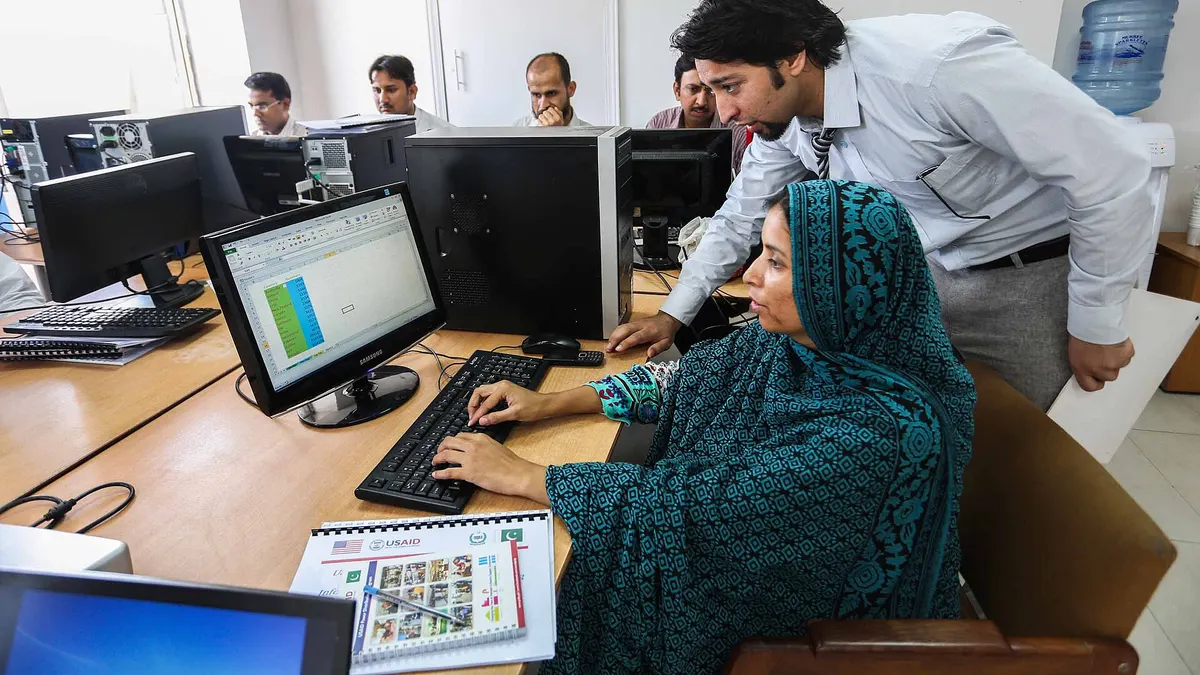
Photo: Uroojmirza71 / CC BY-SA 4.0
Tax & Registration
Salary tax calculator for 2026-27: enter your monthly salary to see the tax your employer deducts under FBR's new slabs, your take-home pay and last year's tax.
Tax & Registration
Non-filers pay 10.5% to 18.5% tax on buying property against 1.25% for filers, 11.5% vs 2.75% on selling, and double on bank profit. Full table, tax year 2027.
Tax & Registration
Freelancer tax: banks deduct 0.25% of IT export earnings if you're PSEB-registered and 1% if not. It's final only if you file a return. Tax year 2027 rules.